Rotor & Wear Parts
- V-arranged rotor blades distribute shredding force across the cutting assembly.
- In an industrial metal double shaft shredder, this arrangement supports balanced engagement as irregular material enters the cutters.
- CrMoV alloy steel blades combine cutting capability with resistance to wear.
- Application-specific cutter materials and configurations are available to suit differences in feedstock hardness, toughness and form.
- DC53/D2 high-alloy wear-resistant moving cutters are also used within the SYU series.
- Your SYU61Series two shaft shredder supplier should specify the exact alloy and arrangement in the blade schedule for the supplied machine, since different cutter builds cannot be treated as interchangeable simply because they belong to the same series.
- HARDOX wear-resistant steel plates protect the double-sided chamber walls against abrasion.
- These surfaces are particularly relevant where hard fragments repeatedly contact the chamber during processing.
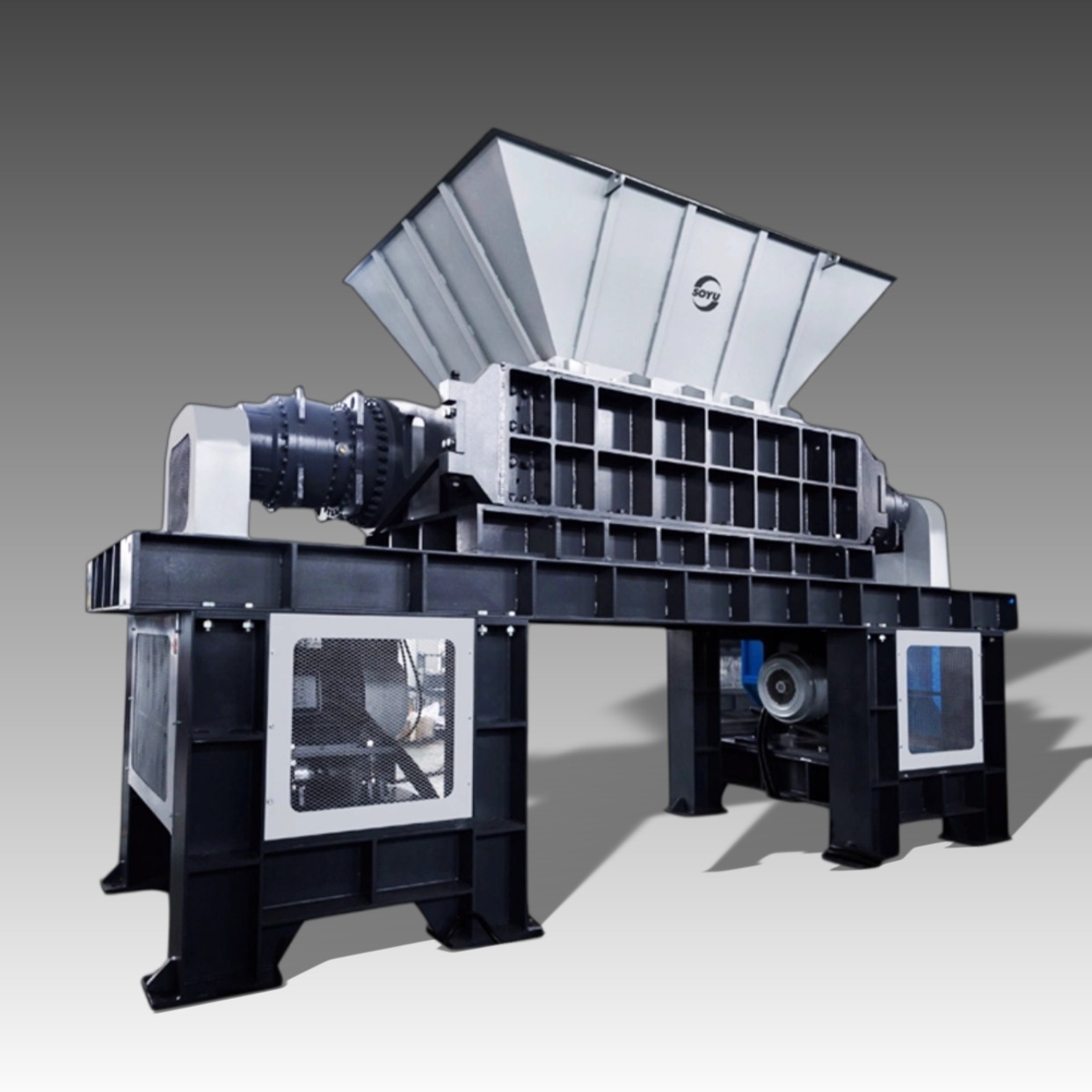
- A thickened frame supports the mechanical loads associated with high-torque operation.
- Its heavy-duty construction is intended for the stresses generated by large or hard feedstock.
- Multi-faceted regrinding and cutter refurbishment allow serviceable blades to return to use rather than being discarded at the first sign of a worn edge.
- Remaining cutter condition, damage and the permitted geometry determine whether refurbishment is appropriate.
SYU Family Specifications
| Model | Motor power | Blade dimension | Blade cutting diameter | Main blade quantity | External dimensions | Equipment weight |
|---|
| SYU1940 | 7.7 kW | 18.5 mm | Ø245 mm | 20 | 1,860 × 900 × 1,800 mm | 1,400 kg |
| SYU1960 | 2 × 7.5 kW | 18.5 mm | Ø245 mm | 30 | 1,950 × 900 × 1,800 mm | 1,600 kg |
| SYU1980 | 2 × 11 kW | 18.5 mm | Ø245 mm | 42 | 2,180 × 900 × 1,800 mm | 1,800 kg |
| SYU2360 | 18.5 kW | 25 mm | Ø290 mm | 24 | 2,300 × 1,000 × 1,950 mm | 3,000 kg |
| SYU2380 | 22 kW | 25 mm | Ø290 mm | 32 | 2,500 × 1,000 × 1,950 mm | 3,500 kg |
| SYU23100 | 22 kW | 25 mm | Ø290 mm | 40 | 2,700 × 1,000 × 1,950 mm | 4,000 kg |
| SYU2680 | 18.5 kW | 40 mm | Ø320 mm | 20 | 2,410 × 1,100 × 2,050 mm | 4,200 kg |
| SYU26100 | 22 kW | 40 mm | Ø320 mm | 25 | 2,810 × 1,100 × 2,050 mm | 4,600 kg |
| SYU26120 | 22 kW | 40 mm | Ø320 mm | 30 | 3,010 × 1,100 × 2,050 mm | 5,000 kg |
| SYU3380 | 2 × 22 kW | 50 mm | Ø430 mm | 16 | 3,000 × 1,250 × 2,150 mm | 4,700 kg |
| SYU33100 | 2 × 30 kW | 50 mm | Ø430 mm | 20 | 3,000 × 1,250 × 2,150 mm | 5,200 kg |
| SYU33120 | 2 × 30 kW | 50 mm | Ø430 mm | 24 | 3,000 × 1,250 × 2,150 mm | 5,700 kg |
| Model | Motor power | Blade dimension | Blade cutting diameter | Main blade quantity | External dimensions | Equipment weight |
| SYU41100 | 2 × 30 kW | 50 mm | Ø534 mm | 20 | 3,660 × 1,700 × 2,650 mm | 9,000 kg |
| SYU41140 | 2 × 37 kW | 50 mm | Ø534 mm | 28 | 3,660 × 1,700 × 2,650 mm | 10,000 kg |
| SYU41160 | 2 × 45 kW | 50 mm | Ø534 mm | 32 | 3,660 × 1,700 × 2,650 mm | 11,000 kg |
| SYU50130 | 2 × 55 kW | 50 mm | Ø650 mm | 32 | 4,200 × 2,100 × 3,000 mm | 13,000 kg |
| SYU50180 | 2 × 55 kW | 50 mm | Ø650 mm | 36 | 4,200 × 2,100 × 3,000 mm | 14,000 kg |
| SYU50180 | 2 × 75 kW | 75 mm | Ø800 mm | 24 | 5,400 × 2,400 × 3,700 mm | 20,000 kg |
| SYU61210 | 2 × 90 kW | 100 mm | Ø800 mm | 21 | 5,400 × 2,400 × 3,700 mm | 23,000 kg |
| SYU80210 | 2 × 225 kW | 150 mm | Ø980 mm | 14 | 7,100 × 2,900 × 4,200 mm | 26,000 kg |
| SYU80250 | 2 × 225 kW | 150 mm | Ø980 mm | 17 | 7,100 × 2,900 × 4,200 mm | 29,000 kg |
| SYU80300 | 2 × 225 kW | 150 mm | Ø980 mm | 20 | 7,100 × 2,900 × 4,200 mm | 32,000 kg |
Cutter Servicing & Cleaning
- Split bearing seats simplify access during bearing disassembly and assembly.
- Before opening the machine, isolate the electrical supply and any hydraulic energy, then follow the maintenance procedure for the fitted assembly.
- The hydraulic flap door provides access for cutter changes and foreign-object cleaning.
- Plan the task around the material left in the chamber so loose pieces can be removed without exposing personnel to unsupported or trapped material.
- Cutter inspection should track chipped edges, uneven wear, fastener condition and changes in material engagement.
- Build the inspection schedule from actual wear observations and operating conditions rather than assuming the same interval for every waste stream.
- Sectional screen-mesh replacement allows attention to worn areas where a screen assembly is fitted.
- Check the surrounding supports and seating surfaces at the same time so replacement sections sit correctly.
- Bearing and drive checks should follow the lubrication and inspection instructions for the installed components.
- Changes in vibration, temperature or sound are useful reasons to investigate before continuing normal production.
- A controlled restart follows chamber cleaning or component work.
- Check that tools and loose parts have been removed, access points are closed and guards are restored before introducing material and observing the machine under load.
Drive & Safety Controls
As your metal drum shredder manufacturer, we offer electric motor and hydraulic drive arrangements for different operating requirements. A planetary gearbox supports the low speed high torque shredder configuration, with the drive matched to the cutting assembly rather than selected from motor power alone.
DIN 5480 splined shafts connect the reducer and rotor. This German industrial-standard connection provides a defined torque-transmission interface between these assemblies.
Siemens PLC control provides automatic fault detection and overload protection. Fault information helps the operator identify an interruption before deciding whether the cause requires a process adjustment or maintenance attention.
Touchscreen operation brings automatic start-stop and reverse functions into the operating interface. The control arrangement supports single-person machine operation, while site procedures still determine staffing around loading, discharge and maintenance work.
Mechanical torque limitation and electrical safeguards provide separate layers of overload protection. These protective functions help manage abnormal loading; they do not make unsuitable foreign objects acceptable feedstock.
Remote monitoring supports observation of operating status without requiring every check to take place at the local panel. The available monitoring functions belong to the installed control configuration.
Efficient operation and control of dust and noise are part of the drive and process design. Actual environmental performance depends on the material, feed method and surrounding installation, so operating conditions must remain consistent with the site's applicable limits.
Material Applications
- Metal drums and metal chips create different feeding conditions for an industrial metal double shaft shredder.
- Hollow containers need room to enter and engage, while loose or tangled chips require attention to how material is metered into the chamber.
- Electronic scrap includes board-containing assemblies and scrap electric motorcycles.
- Batteries, stored energy, fluids and components requiring separate treatment should be removed through the appropriate preparation process before mechanical shredding.
- Paper and cardboard applications range from loose sheets to bulky packaging.
- The way this material is presented to the hopper affects bulk handling, especially where lightweight pieces bridge or arrive in uneven batches.
- Plastic and film applications include feedstocks with very different stiffness and bulk density.
- Rigid pieces and flexible film should be treated as distinct processing conditions when defining the cutting and feeding arrangement.
- Refuse-derived fuel preparation and municipal solid waste processing involve variable mixtures.
- The acceptable feed composition and downstream treatment route must be defined for the installation; size reduction alone does not complete a waste-treatment process.
- FRP and fiberglass applications involve reinforced composites whose resin, fiber content and shape influence cutting behavior.
- Control of released fibers and dust belongs to the surrounding handling and extraction arrangement.
- Wood and wood-pallet processing involves changes in section size, joint construction and attached hardware.
- Material preparation should distinguish clean timber from items carrying fittings or contaminants that fall outside the agreed feed specification.
- Tire processing combines flexible rubber with reinforcing components.
- Tire construction and the required subsequent processing determine the appropriate operating setup; the application name alone does not establish a finished rubber product.
Large, tough recycling feedstock calls for controlled reduction and a machine that can be kept in working order between production runs. Built for industrial recycling and solid waste treatment, our low speed high torque shredder brings demanding material handling and practical servicing into the same machine. Recycling operators can use it within a new line or alongside existing processing equipment, with the working configuration matched to the waste stream. The emphasis is straightforward: prepare bulky material for further processing while keeping routine operating and service tasks manageable.
Product Videos & Cases
- Metal drum demonstrations provide a useful view of how container shape affects entry into the cutting zone.
- Examine the loading method and the way the container is presented, rather than drawing a production rating from a short clip.
- Tire demonstrations help illustrate the handling of resilient feedstock.
- Watch how material settles into the chamber and whether additional handling is used during the demonstrated run.
- Paper demonstrations offer a closer look at the movement of lightweight, bulky material.
- The feed presentation in the demonstration is an important part of understanding the operating behavior.
- Scrap electric motorcycle demonstrations show a more complex feed form than individual production offcuts.
- Compare the preparation and remaining assembly structure with the material your operation intends to process.
- FRP demonstrations address reinforced composite pieces.
- Part shape and the way each piece approaches the cutters are useful details to examine alongside the resulting material form.
- Board-shredding demonstrations cover electronic-board feed.
- Examine the board dimensions and attached components represented in the demonstration before applying the same expectations to a different board stream.
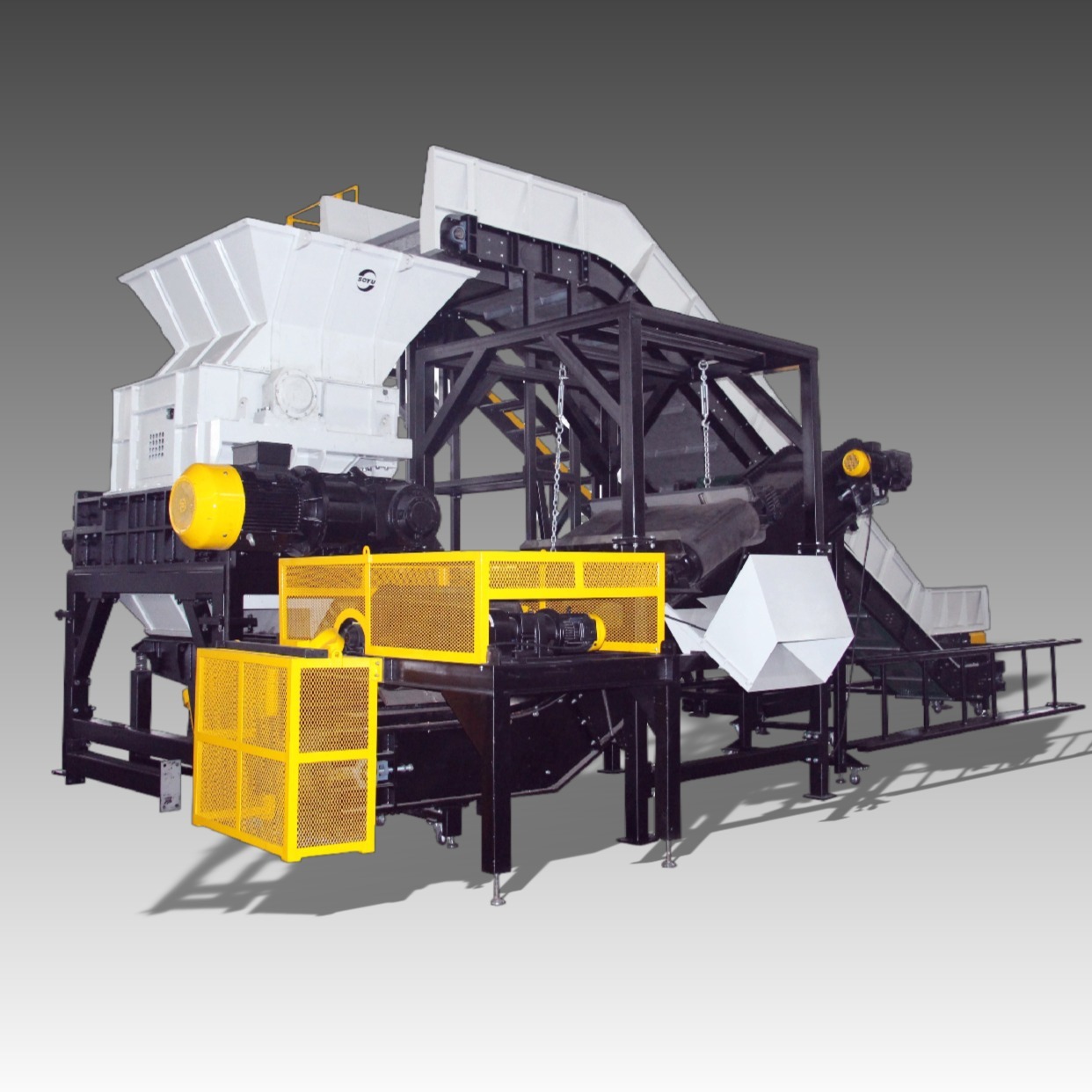
- Conveyor-fed system examples illustrate how shredding can sit within a larger material-handling arrangement.
- Compare the transfer points, direction of flow and operator access with the arrangement required for your own installation.
Feeding & Installation
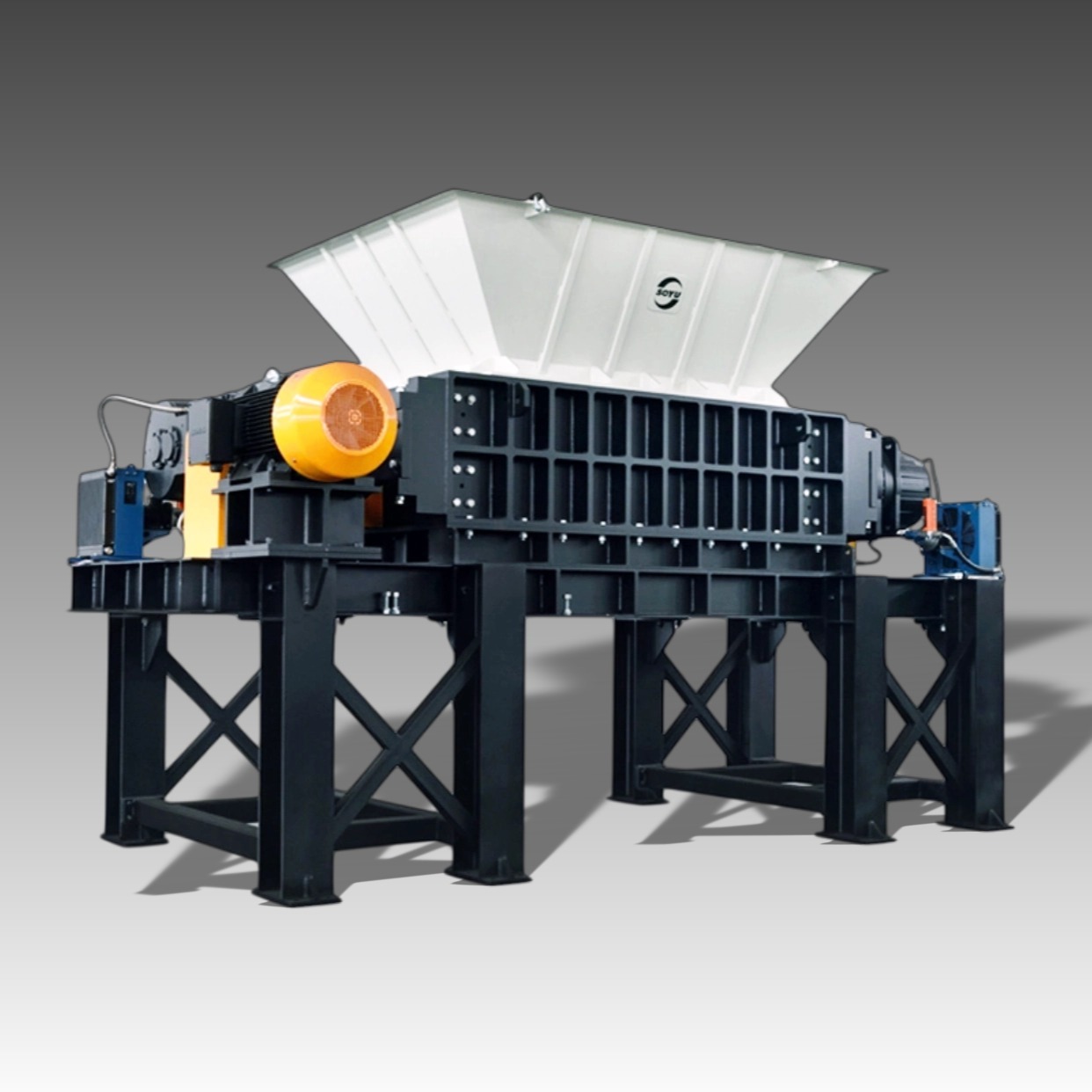
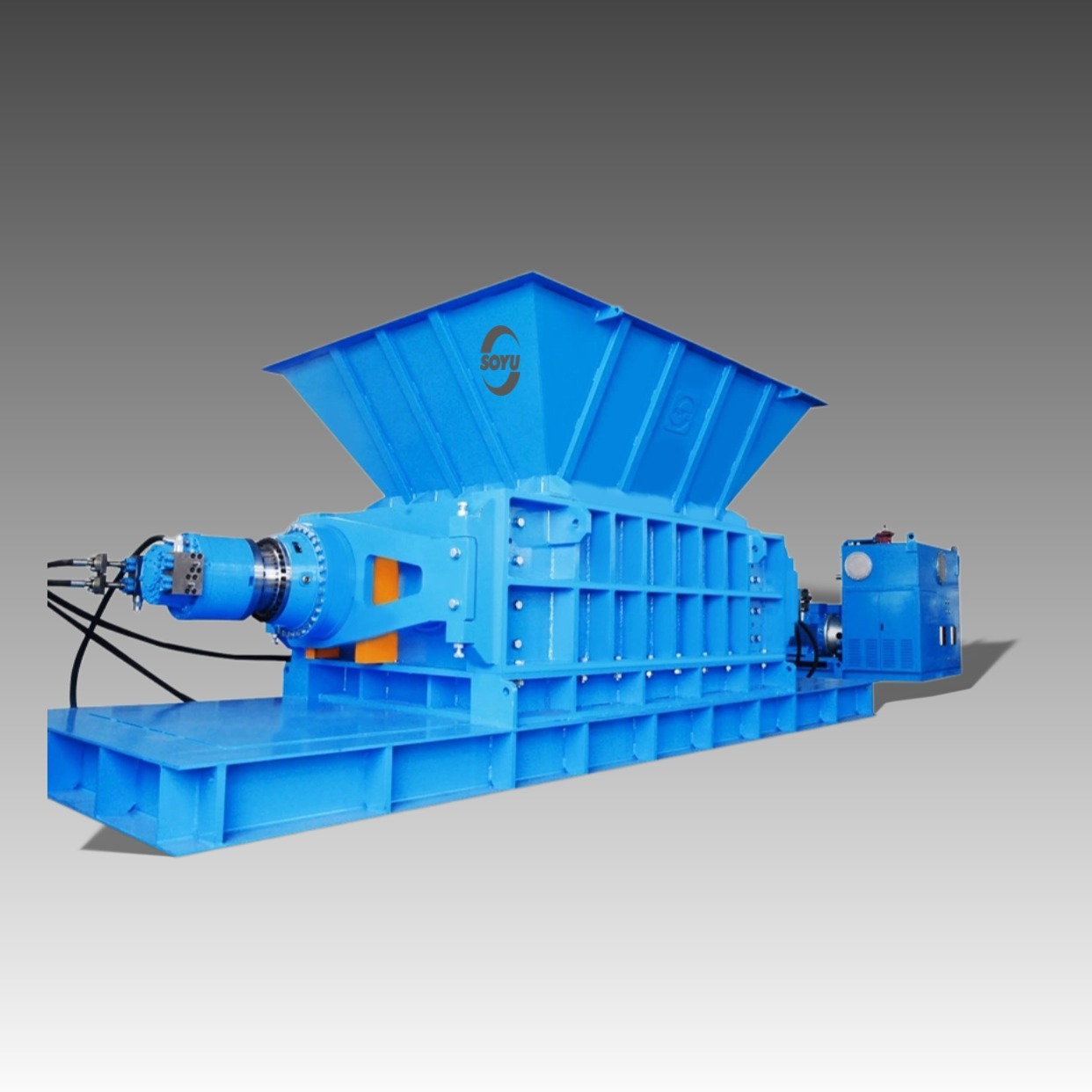
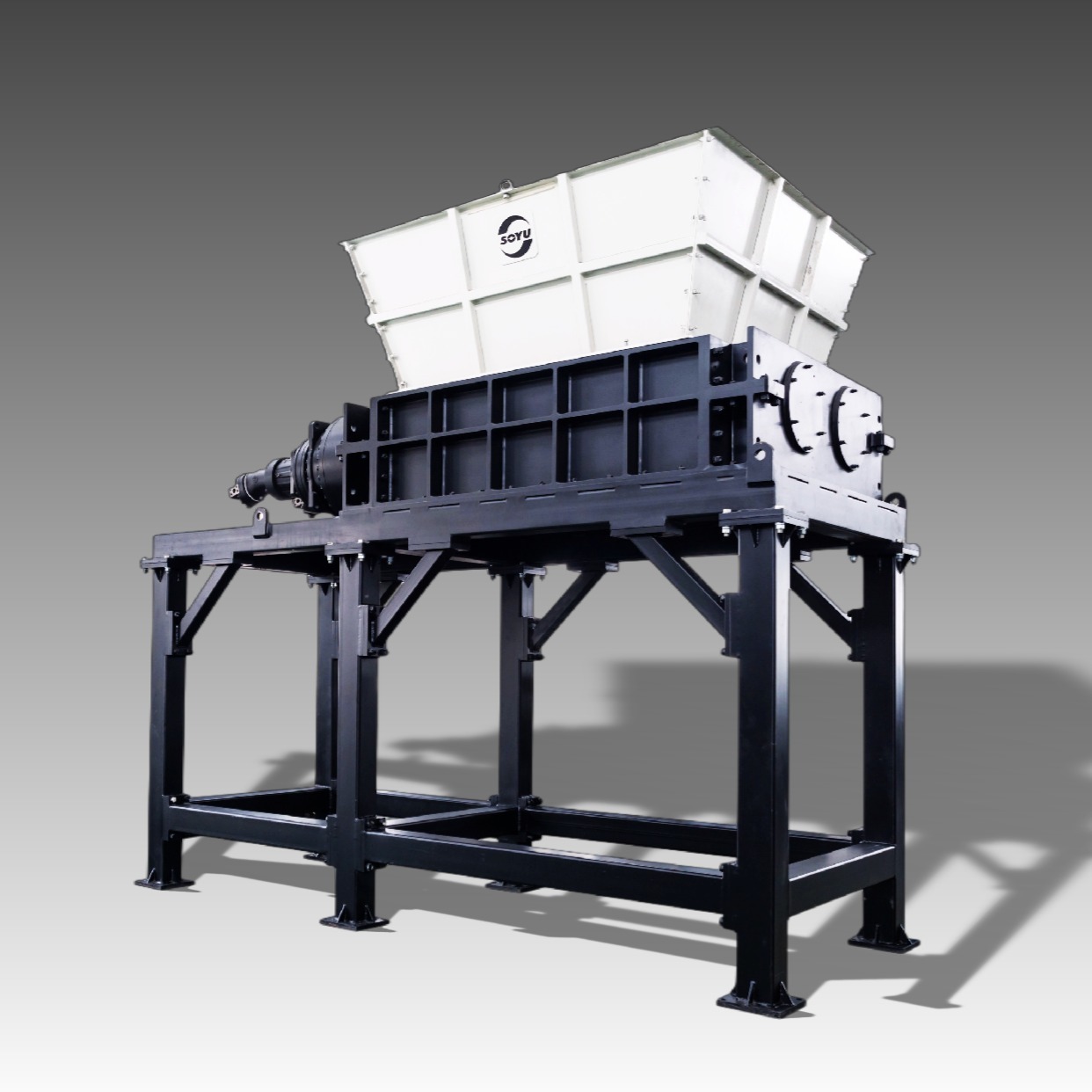
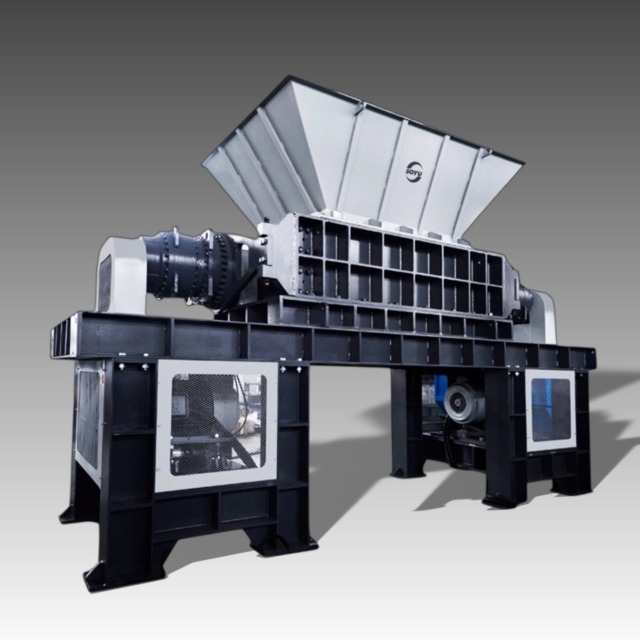
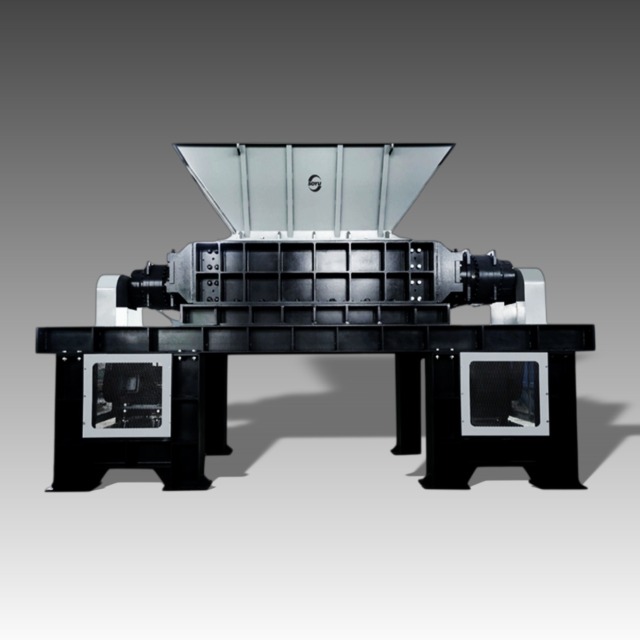
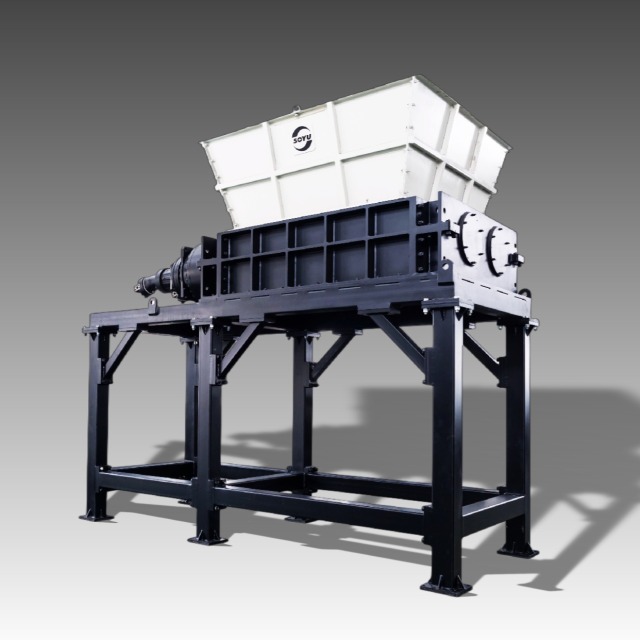
A flared open feed hopper provides a broad entry for material approaching the cutting chamber. The loading arrangement needs to deliver material into this opening without creating an uncontrolled drop or obstructing access around the machine.
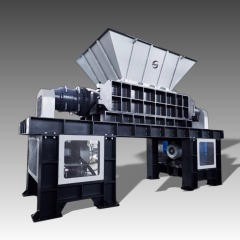
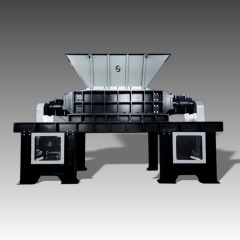
Side-mounted motor assemblies occupy space beyond the central shredding body. Installation drawings should allow access to these assemblies for inspection and removal, rather than treating the chamber outline as the complete service envelope.
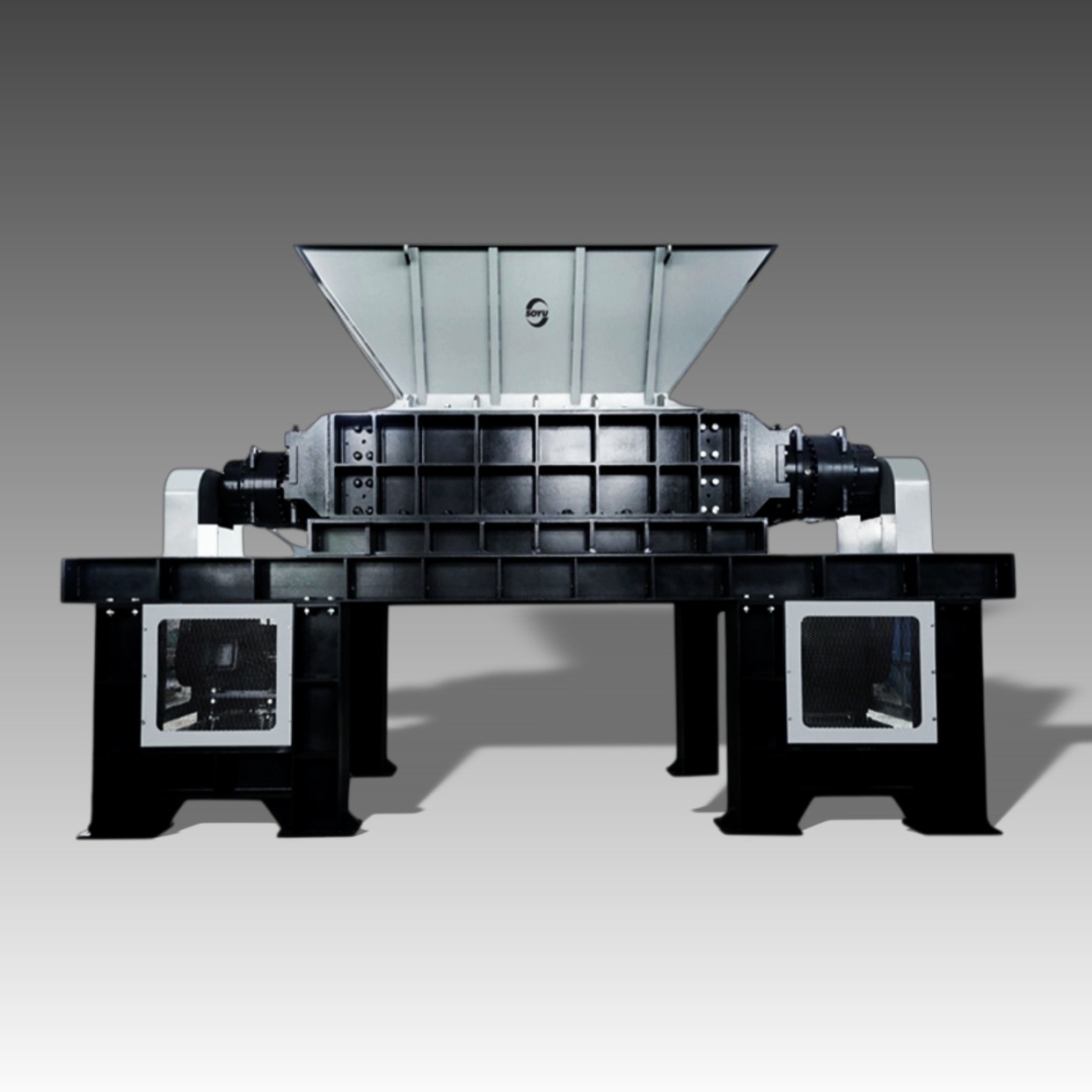
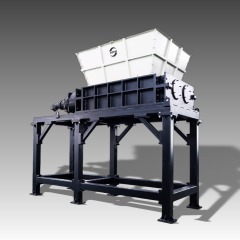
The elevated, cross-braced support frame carries the shredder above the discharge area, while the chamber has a ribbed exterior. Foundation loading, lifting arrangements and working clearances need to be established from the approved installation drawing for the supplied machine.
Mesh drive guards separate personnel from moving drive components. Access routes and nearby equipment should allow those guards to remain in place during normal production and to be handled correctly during maintenance.
A discharge chute directs reduced material away from the cutting assembly. The receiving arrangement should prevent material from accumulating back toward the outlet and leave room for inspection of the transfer area.
An optional hydraulic handling arm can be installed for special material-handling requirements. It is not standard equipment on ordinary dual-shaft machines; where the feedstock benefits from assisted handling, the arm can help improve material presentation and production capacity, depending on the application.
Ordering & Replacement Parts
- Original spare parts remain available at cost after the warranty period ends.
- This policy applies to original replacement parts supplied for the equipment.
- SOYU can supply the configured machine as your SYU61Series two shaft shredder supplier.
- The equipment agreement should identify the supplied assemblies and applicable warranty terms.
- Metal drum projects can be specified directly with SOYU as your metal drum shredder manufacturer.
- The agreed machine configuration belongs in the equipment specification attached to the order.
- An English operation and maintenance manual is provided with every machine.
- Keep the machine identification, installed component details and any later component changes with the maintenance records to support accurate replacement-part orders.
Professional Certification
| Property | Detail |
|---|
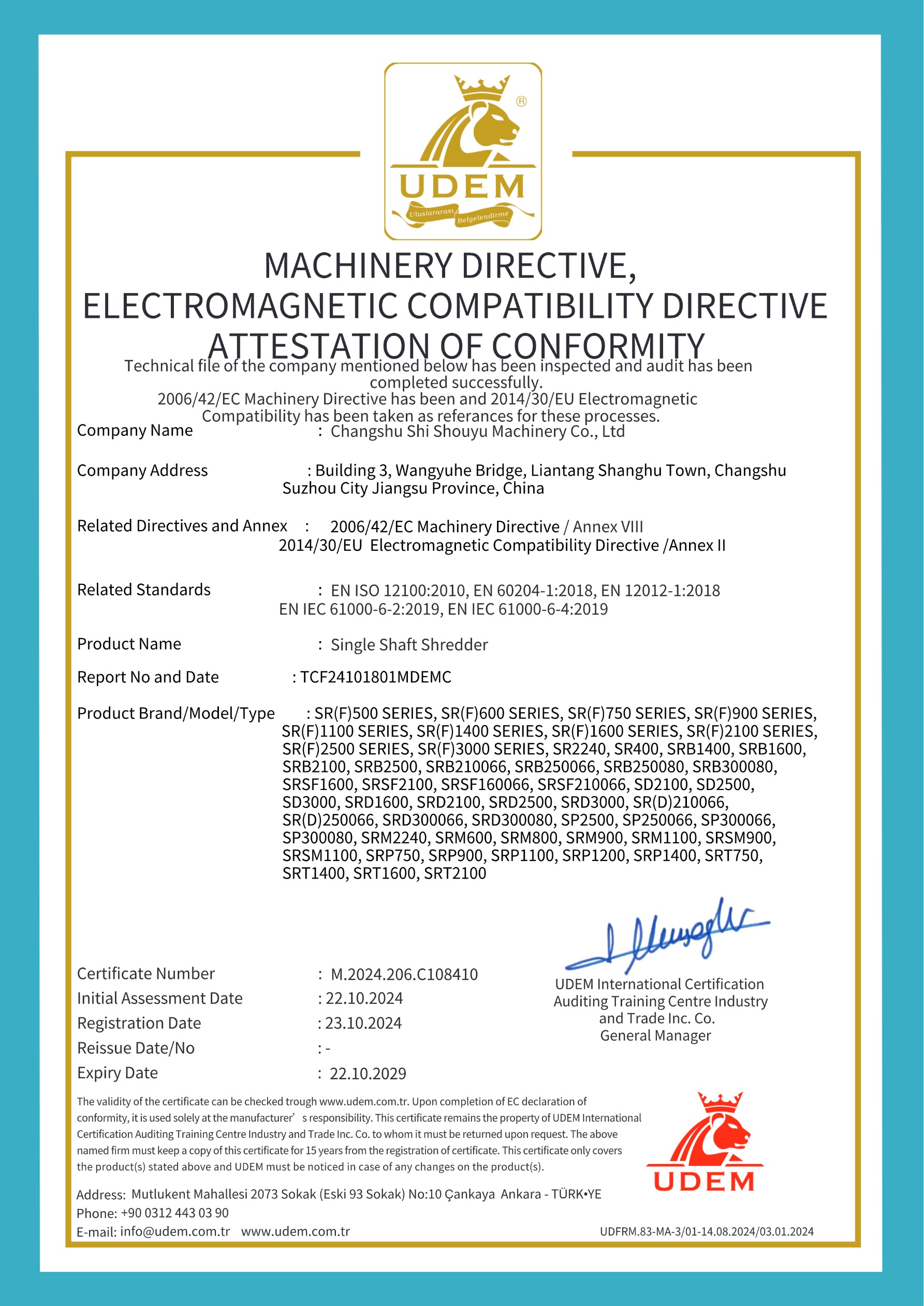
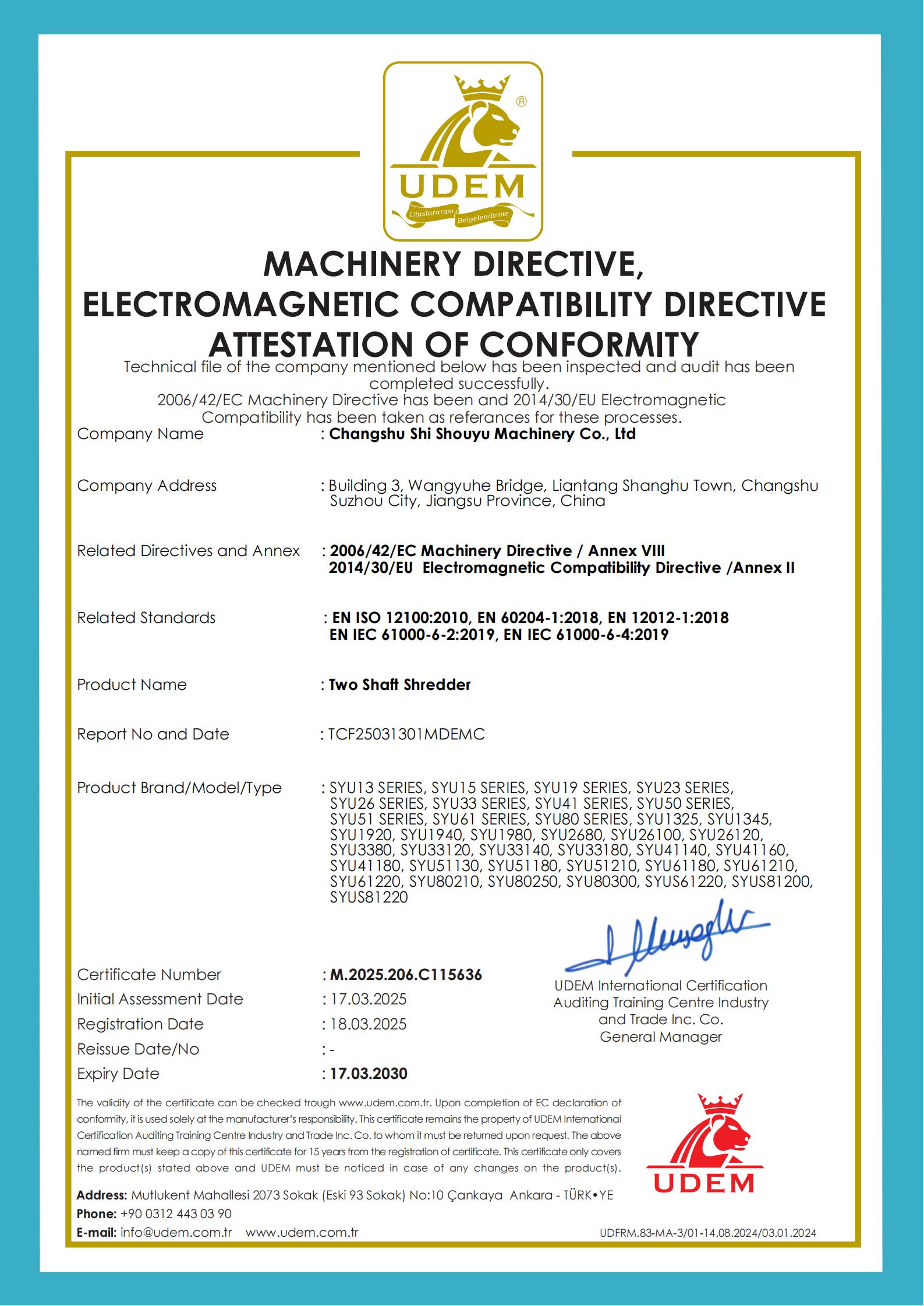
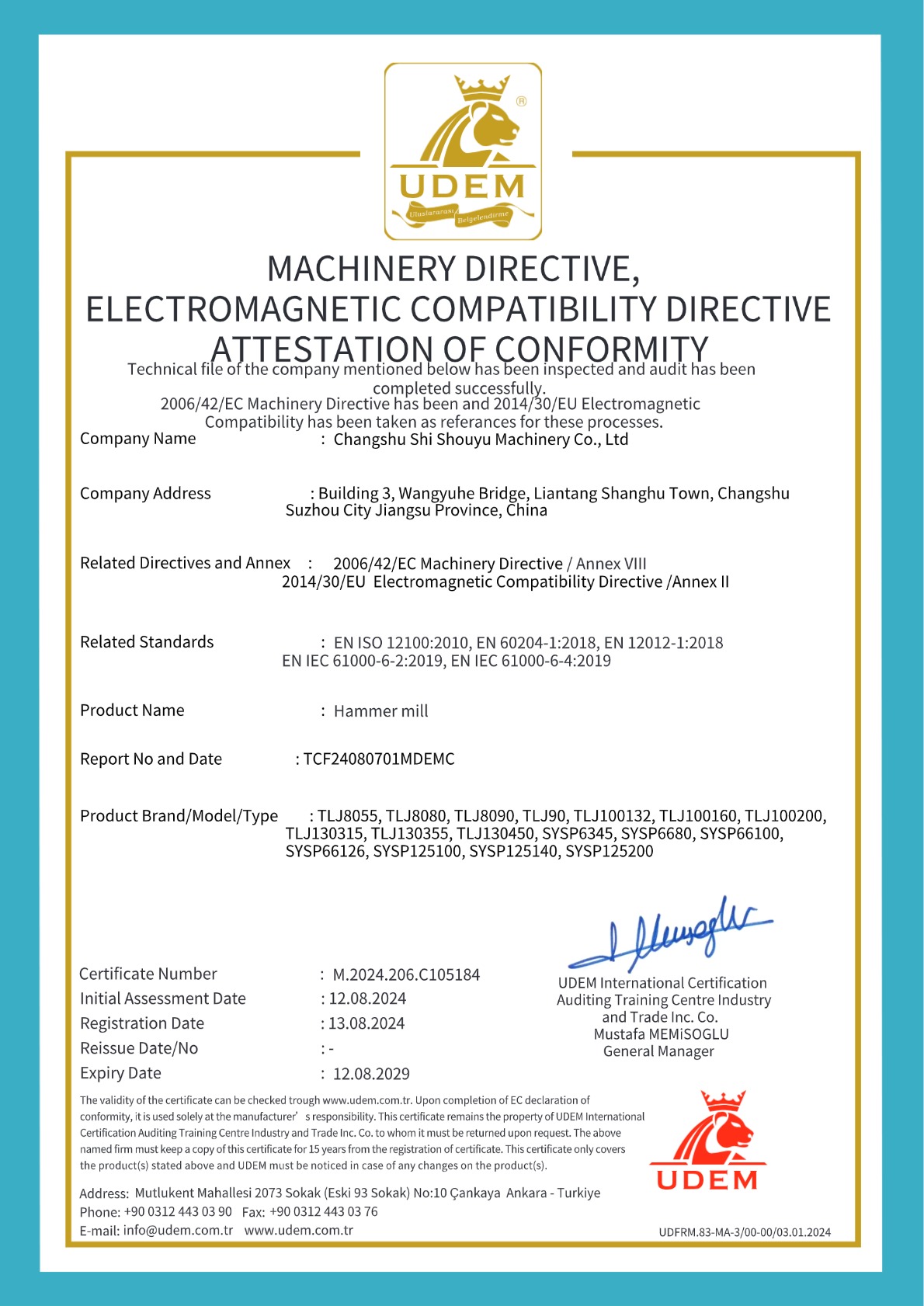
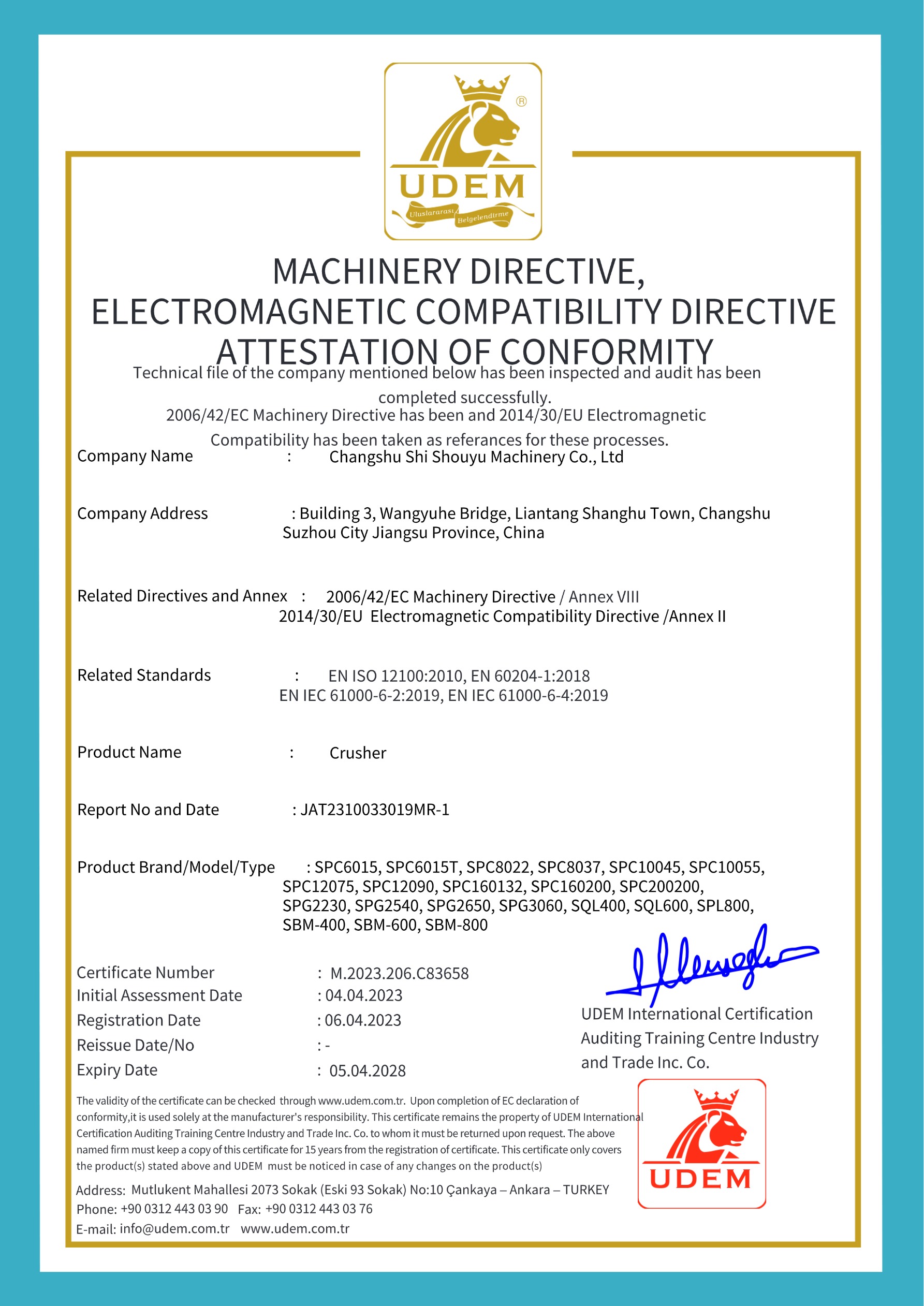
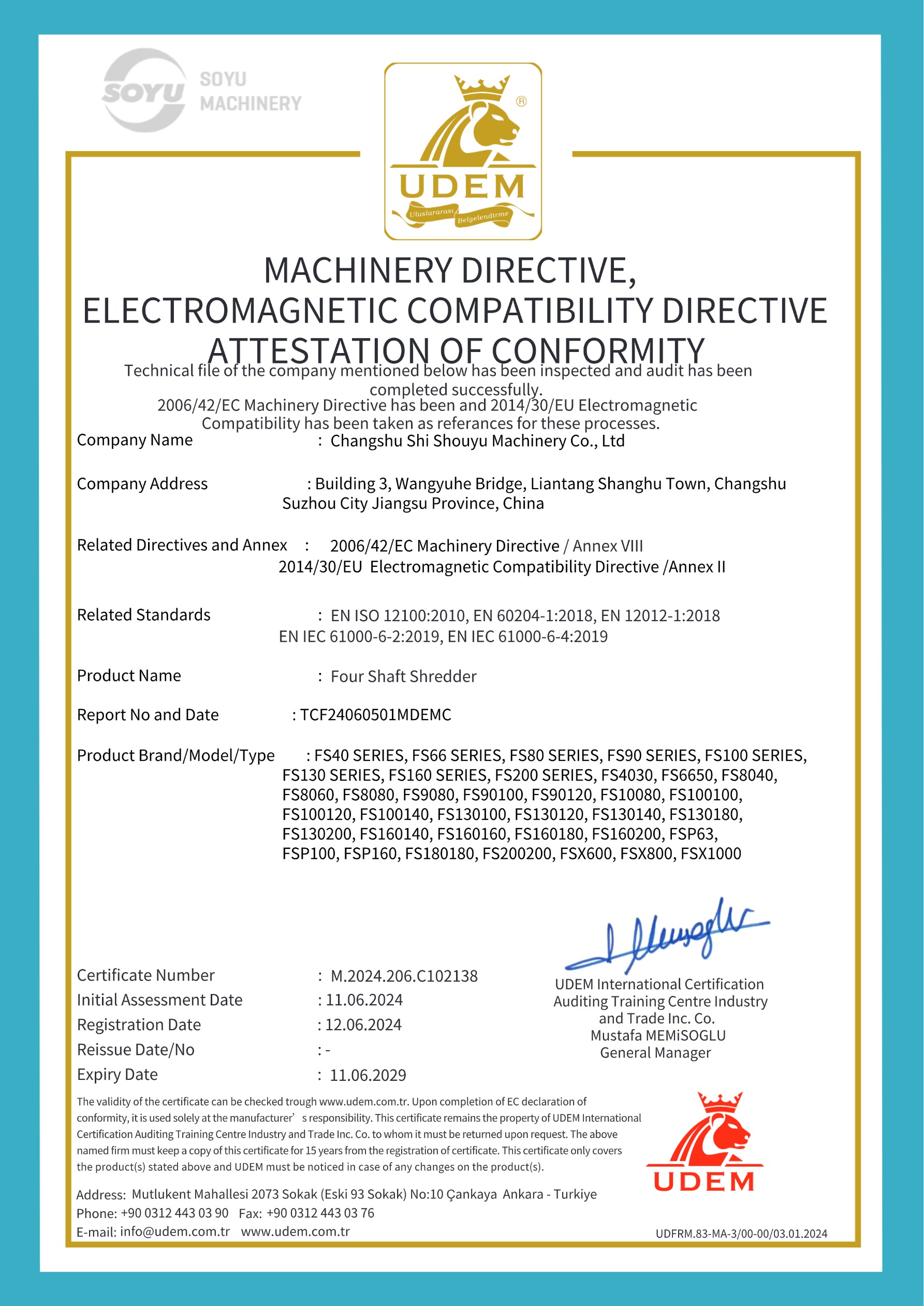
| Product conformity | EU CE certification |
| CE framework | EU Machinery Directive 2006/42/EC |
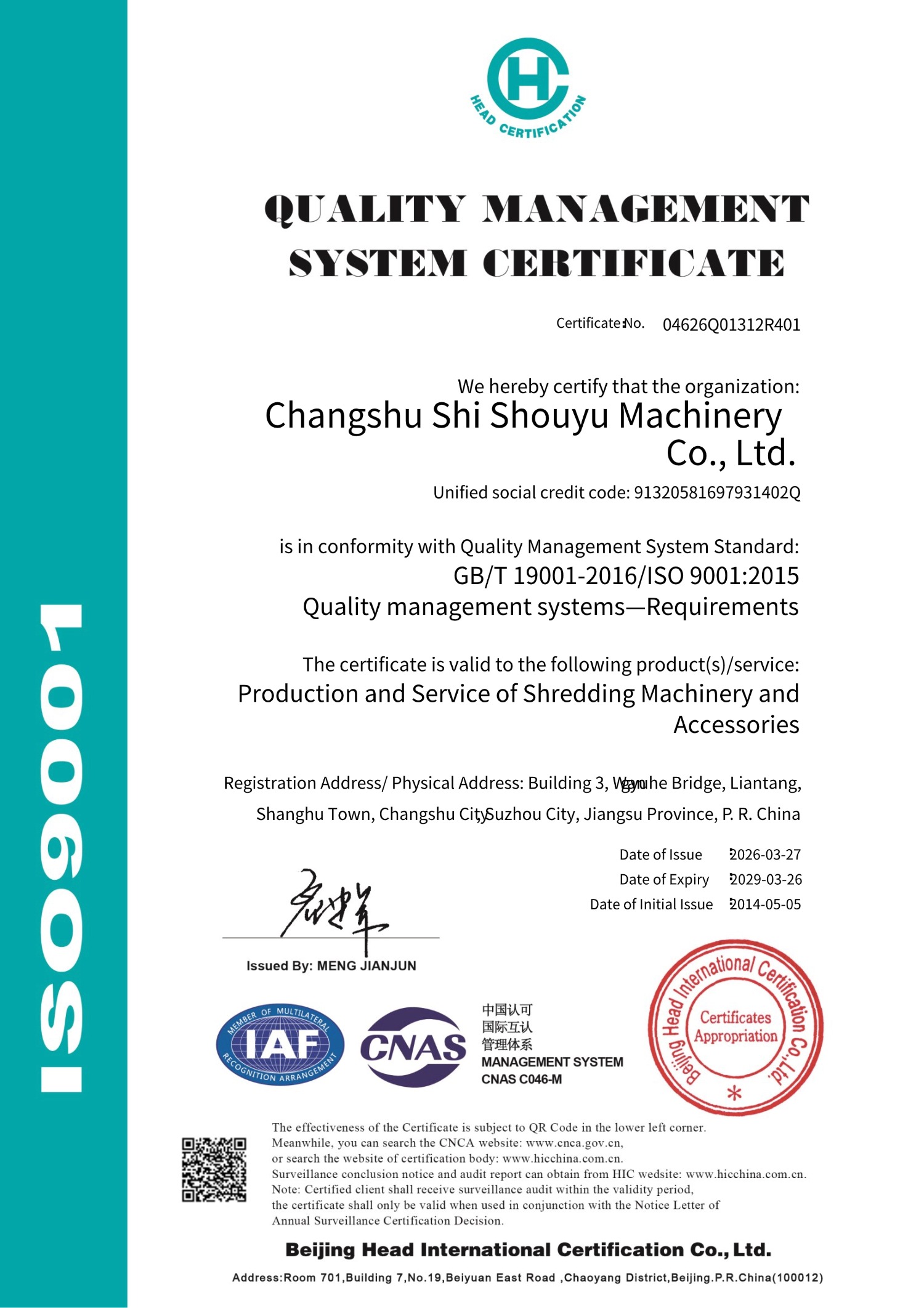
| Quality management system | ISO 9001:2015 |
| Manufacturing quality | Full-process quality control within SOYU's ISO 9001-certified manufacturing system |
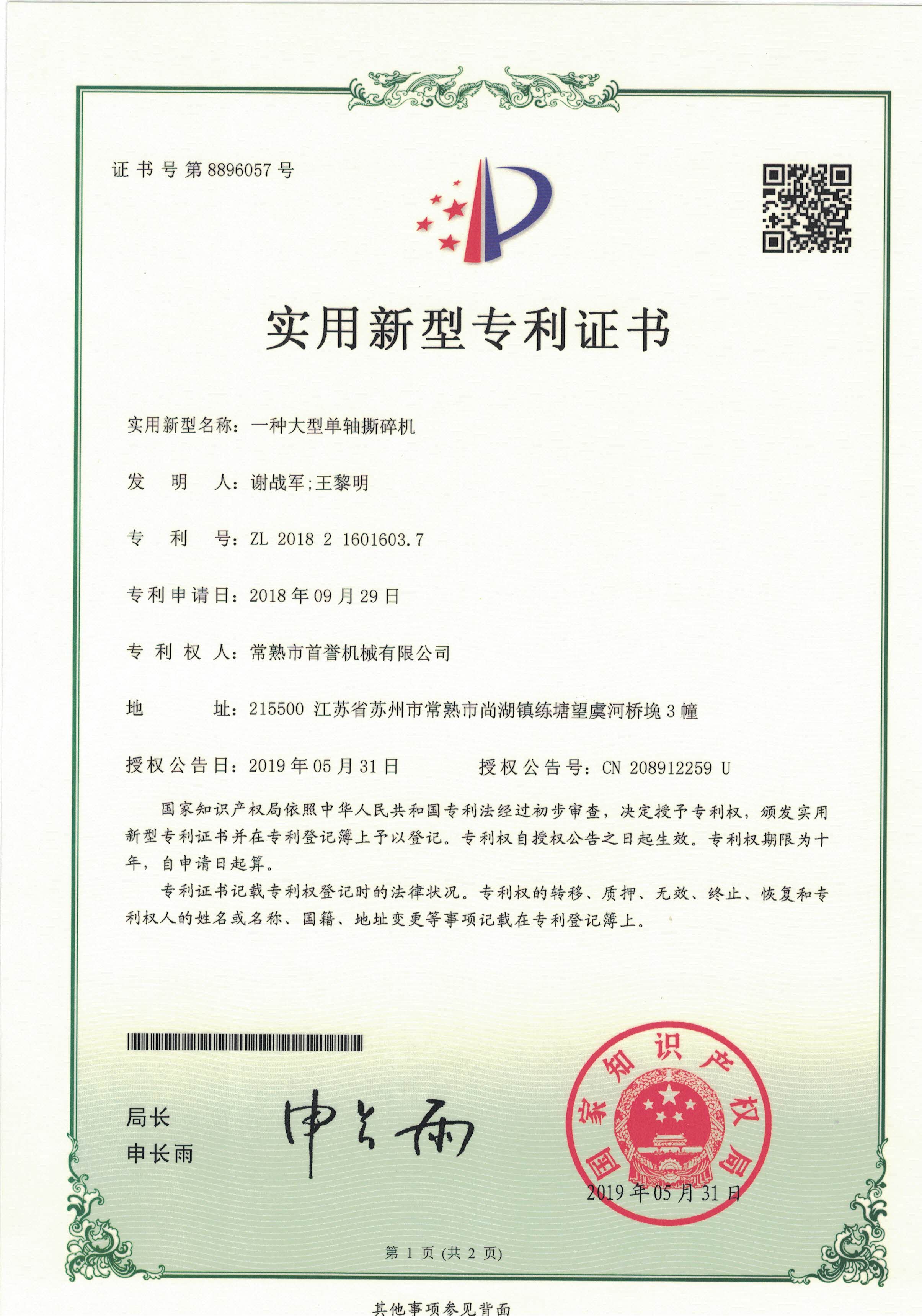
| Core technology patents | More than 80 national patents across SOYU technologies |
| Manufacturer | CHANGSHU SHI SHOUYU MACHINERY CO., LTD. (SOYU) |
| Technology platform | 3E Series, established in 2009 |
Shredder Performance Testing
- Test batch: Agree a representative feed batch and acceptance criteria with SOYU before testing the SYU61Series.
- Record batch weight, material proportions, incoming dimensions, moisture and bulk density so the results relate to the material your plant will actually receive.
- Machine conditions: Record the exact model, fitted cutters, cutter condition, operating settings and loading method for each run.
- Keep these conditions consistent when comparing results; a change in feed preparation or cutter condition can change both processing rate and electricity consumption.
- Throughput measurement: Weigh the material processed and divide that mass by the measured elapsed time to calculate tonnes per hour.
- Record feeding interruptions, reversals, blockages and discharge delays separately.
- Report both the rate during active processing and the average over the complete run so short bursts do not stand in for sustained production.
- Electricity measurement: Read actual electricity use in kWh over the same interval used for the throughput calculation, then divide by the processed tonnes to obtain kWh/t.
- State whether the material weight is measured as received or on a dry basis.
- Installed motor power in kW does not establish electricity consumption per tonne.
- Measurement scope: Identify which equipment the electricity reading includes.
- Shredder-only consumption and consumption for a complete line with feeding, conveying, separation and extraction need separate labels.
- Include idle periods consistently when comparing operating costs.
- Discharge acceptance: Collect output samples throughout the run and check them against your required size distribution, remaining attached materials and contamination limits. For steelmaking projects, include the receiving mill's requirements for piece dimensions, bulk density, coatings and non-metallic content. Shredder throughput alone does not establish separated-material quality or furnace acceptance; any additional processing needed to meet those requirements belongs in the proposed line design.
- Usable output: Where separation or further processing is required, weigh the accepted product, material needing another pass and rejects separately.
- Calculate usable tonnes per hour and line electricity consumption per accepted tonne alongside the shredder figures.
- These measurements show how much saleable or reusable material the proposed process produces, rather than only how much feed passes through the cutting chamber.
Technical Support & Model Matching
Choose equipment matched to your operating requirements with technical support from SOYU. We review your material characteristics, target throughput, site conditions and environmental requirements to recommend suitable models and configurations. Our support covers installation, commissioning and operator training to help your team prepare for operation. Overseas customers can access remote technical assistance for troubleshooting, while maintenance and original spare parts support continue after delivery. Original spare parts remain available at cost after the warranty period ends.
FAQ
How does the shaft design help with wrapping material?
Differential dual-axis operation and hexagonal blade shafts form part of the anti-entanglement design, helping manage how material engages with the cutting assembly. Long, flexible pieces still need careful preparation because they can loop, bunch or wind around rotating components.
Film strips, textile offcuts and loose strapping present different wrapping challenges from compact pieces. For these materials, assess the length and form of the incoming feed before deciding whether pre-cutting is needed. Open tangled bundles where practical so that dense knots do not enter together, and remove loose ties or binding straps that are not intended for processing.
Controlled loading also matters. Avoid dropping a large mass of flexible material into the chamber at once; follow the agreed feeding procedure so material can engage progressively. If discharge slows or material begins accumulating, stop feeding and investigate according to the operating instructions. Isolate the machine before attempting to remove wrapped material, and never reach into the chamber during operation.
A trial with representative feed can help establish a workable preparation and loading method. Include the longest pieces and most tangled bundles you expect to handle, since neatly prepared samples may not reveal the wrapping behaviour of everyday deliveries.
Can this machine replace a hammer mill for preparing steelmaking scrap?
The industrial metal double shaft shredder uses cutting and tearing to reduce bulky feedstock. A hammer mill applies impact processing when scrap density and surface-coating removal are part of the required result, so the appropriate machine depends on the processed-scrap requirements.
How can energy consumption be compared for our material?
Material testing can record actual processing capacity and energy consumption for a low speed high torque shredder. Compare those measurements under the same feed composition and discharge requirements, rather than relying on installed motor power as a measure of energy used per unit of material.
Does the shredder separate the materials in mixed scrap?
Mixed scrap needs dedicated separation equipment after shredding to recover individual material streams. Our integrated shredding and sorting systems combine these stages, with the separation method selected for the materials present and the output you want to sell or reuse.
Shredding can expose or release components that were joined together, but bonded layers, coatings and embedded parts may remain attached. Where this limits recovery, further liberation may be needed before sorting can produce a useful result.
For mixtures containing steel, magnetic separation is commonly used to extract ferrous pieces. Conductive non-ferrous metals, such as aluminium, may require an eddy current separator; its suitability depends on fragment size, shape and the surrounding material. Screening can divide the discharge into size fractions for subsequent treatment, while air separation may help remove lighter fractions where differences in weight and shape allow it.
Incoming contamination also affects the result. Identifying unwanted materials before processing helps determine what should be removed upstream and what the sorting stages must handle.
The target should include both recovered-material purity and recovery yield: a cleaner fraction can sometimes mean leaving more valuable material in the reject stream. Representative processing trials and checks of each output fraction help establish the balance for your mixture. Share its composition and your intended outlet requirements so we can discuss an appropriate separation arrangement.